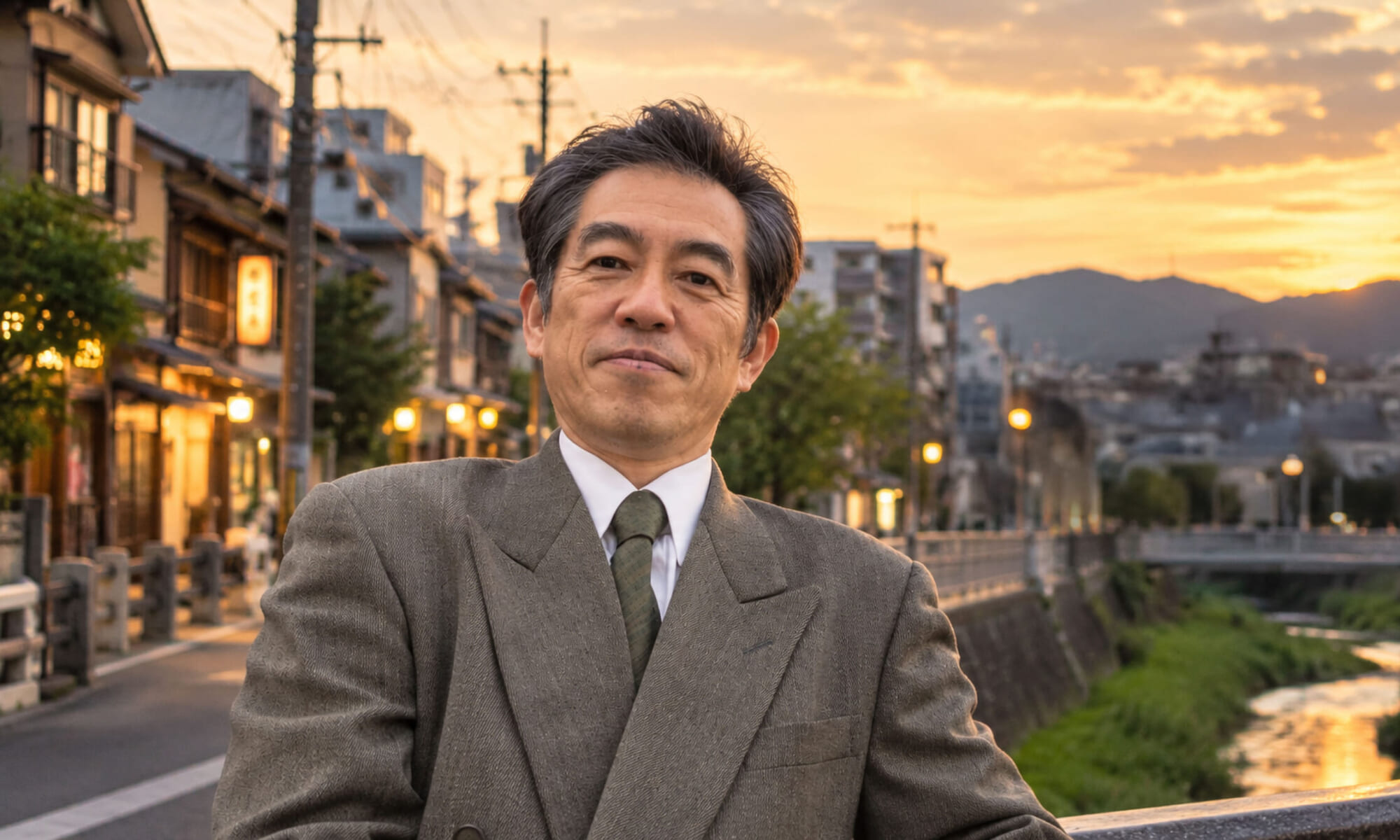
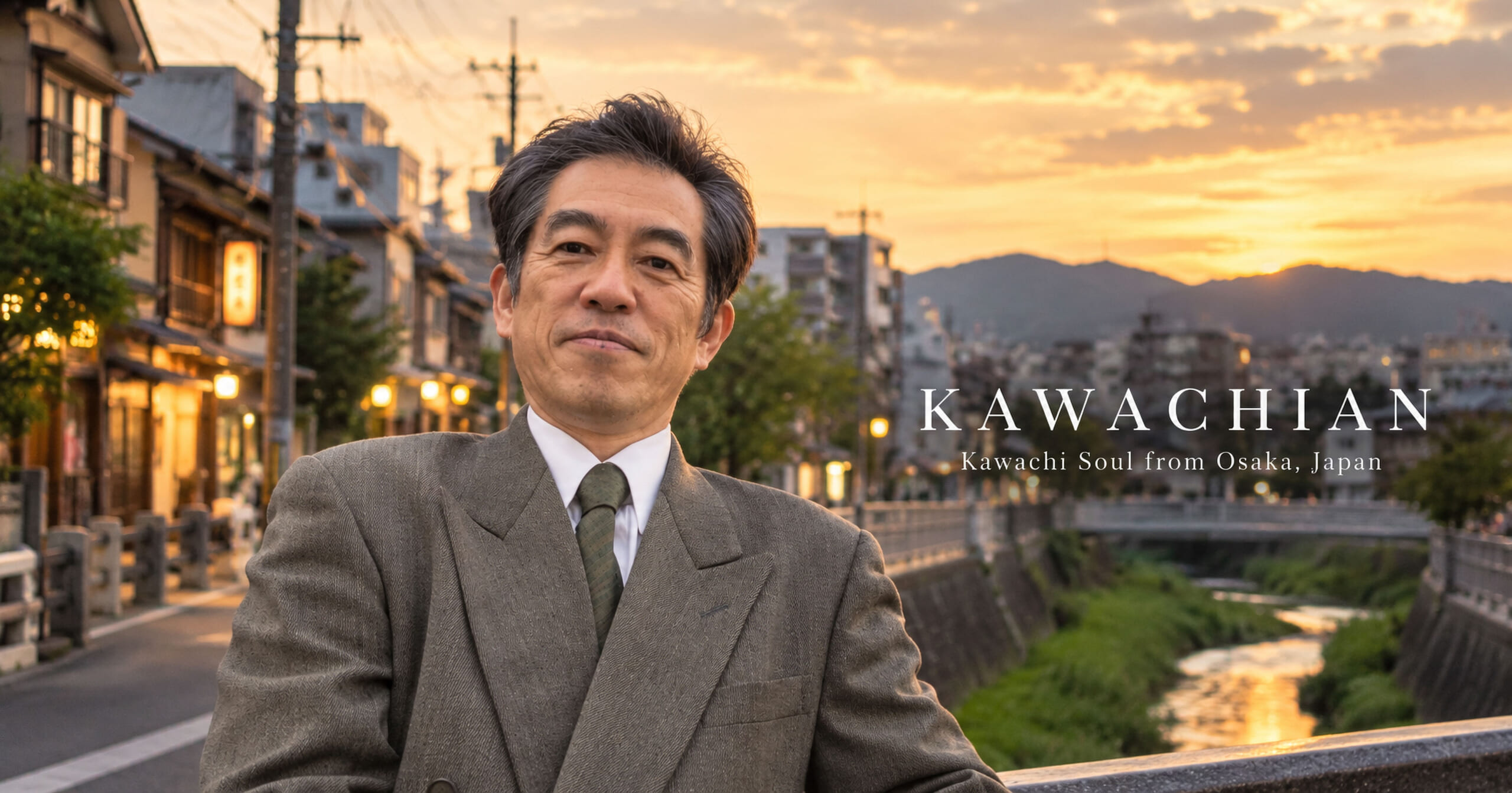
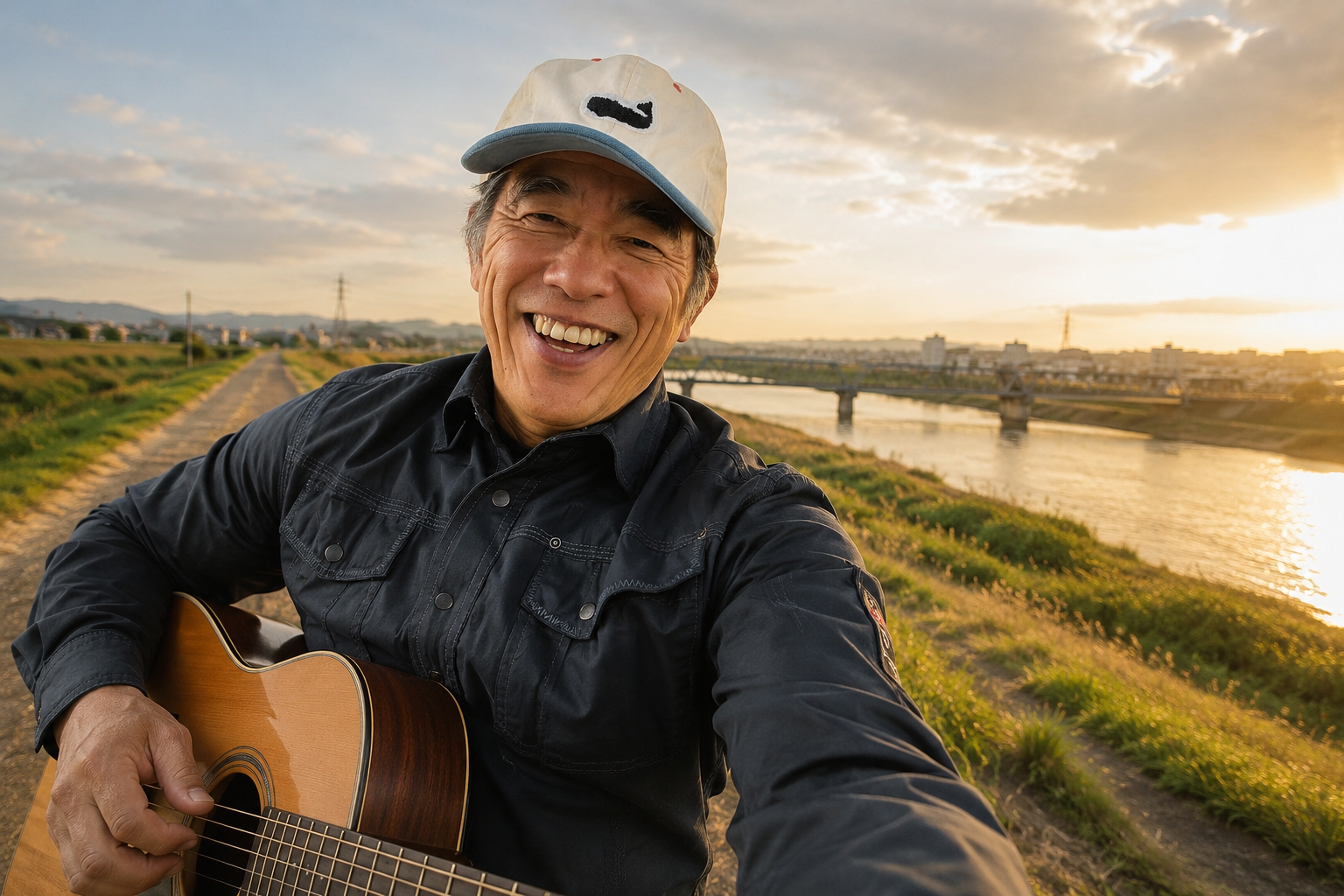
KAWACHIAN is a music project created by singer-songwriter Masaki Wakabayashi, from Kawachi, Osaka, Japan.
On June 6, 2026, at the age of 69, Wakabayashi began his music activities as KAWACHIAN in earnest.
Kawachi Soul from Osaka, Japan
is the phrase at the heart of the project. Through original songs, KAWACHIAN expresses memories of growing up in Kawachi, human warmth, laughter, tears, and the things Wakabayashi has seen through a long life.
Songwriting and composition, singing, vocal recording, mixing, video production, the official website, social media, music distribution, and YouTube promotion are all produced within the project itself.
KAWACHIAN connects Wakabayashi’s lifelong musical sensibility and decades of experience in planning and marketing with today’s tools: AI, video, digital production, and online distribution.
As of October 2, 2026, the KAWACHIAN YouTube channel had passed 100,000 subscribers approximately four months after its debut, reaching 536,000 unique viewers and 823,000 total views.
This page introduces KAWACHIAN’s music, current results, the person behind the project, possible media stories, press information, and official materials.
ABOUT KAWACHIAN
Age 69 Is an Important Part of the Story — But Not the Whole Story
KAWACHIAN is not a project that began simply because Wakabayashi decided to “take on a new challenge at 69.”
Masaki Wakabayashi had played guitar, written songs, and sung since childhood.
At the same time, his professional life involved decades of work in planning, advertising, public relations, sales promotion, and marketing.
After all those years, a new environment emerged in which individuals could use AI, digital music production, video editing, YouTube, and global streaming services by themselves.
Wakabayashi happened to be 69 when those possibilities came together for him.
KAWACHIAN is the project through which the music that had been part of his life since childhood became something he could deliberately take out into the world.
In earlier decades, it was not easy for one person to write music, record it, create visuals, release it directly from Japan to listeners around the world, and then measure the response through data.
Today, it is possible.
KAWACHIAN is an ongoing music project that connects what Wakabayashi has accumulated throughout his life with the tools of a new era.
WHAT IS HAPPENING NOW
100,000 YouTube Subscribers in About Four Months
KAWACHIAN began its full-scale YouTube music activity on June 6, 2026.
As of October 2, 2026, YouTube Analytics recorded:
Total Views
823,000
Unique Viewers
536,000
Total Watch Time
6,342.2 hours
Returning Viewers
8,361
Channel Subscribers
101,637
KAWACHIAN reached the 100,000-subscriber milestone associated with the YouTube Silver Creator Award approximately four months after its debut.
KAWACHIAN is not represented by a talent agency or record label.
Music production, singing, recording, video, the website, social media, and advertising are handled primarily within the project itself.
Rather than treating “100,000 subscribers” as an endpoint, KAWACHIAN continues to examine what is happening through YouTube’s own data.
First Three Songs | YouTube Promotion to International Audiences
For the first three songs,
“NANI YUTENNO”
“EEYANKA”
“NAISHO”
KAWACHIAN ran official YouTube promotions to audiences in Japan and other countries, spending approximately ¥20,000 on each song.
Total Advertising Spend
Approximately ¥60,000
Promoted Views
75,520
Acquired Channel Subscribers
19,635
Acquired Subscribers as a Share of Promoted Views
Approximately 26%
Advertising Cost per Acquired Subscriber
Approximately ¥3.1
Japan-Only Promotion
The same three songs were also promoted separately to audiences in Japan.
“NANI YUTENNO”
1,229 promoted views / 653 acquired subscribers
“EEYANKA”
1,220 promoted views / 735 acquired subscribers
“NAISHO”
1,383 promoted views / 739 acquired subscribers
Across the three songs:
3,832 promoted views / 2,127 acquired subscribers
The number of acquired subscribers relative to promoted views was:
approximately 55.5%
“Of Summer” | ¥34,989 in Advertising and 10,452 Acquired Subscribers
KAWACHIAN then asked another question: if the budget were increased, how long would this level of efficiency continue?
For “Of Summer,” released on July 30, 2026, the official YouTube promotion budget was increased to ¥34,989.
The result was:
Impressions
1,036,695
Promoted Views
109,334
Acquired Channel Subscribers
10,452
Advertising Cost per Acquired Subscriber
Approximately ¥3.35
Even after increasing the budget to roughly 1.75 times the earlier level, the cost per acquired subscriber remained in the ¥3 range at this stage.
The campaign also generated 3,028 follow-on views of other videos.
The “Of Summer” video itself reached 216,576 total views.
This created the next question:
“If the budget is increased further, at what point will this efficiency begin to fall?”
Because of budget limitations, KAWACHIAN has not yet tested the campaign at a substantially larger scale.
The current 100,000-subscriber milestone was therefore not achieved by pushing advertising expenditure to its maximum possible level.
The experiment is still continuing.
Note: YouTube figures on this page are based on official records in YouTube Studio and the YouTube promotion management interface.
THE FIRST HYPOTHESIS
“I Truly Believed We Could Reach 100,000”
When the debut song “NANI YUTENNO” was completed, Masaki Wakabayashi felt unusually confident about it.
His wife, who has always given him direct and candid opinions about his singing, responded positively. His son, a pianist with a sensitive ear for pitch and sound, also reacted strongly. The family felt that the song had something special.
Wakabayashi felt the same.
“This will reach people.”
The 100,000-subscriber milestone associated with YouTube’s Silver Creator Award was not a goal he invented after the numbers began to rise.
It had been one of his first concrete targets from the beginning.
He had even spoken with his family about a much more distant dream: one day reaching NHK’s annual Kohaku Uta Gassen.
Advertising was also part of the plan from the beginning.
Wakabayashi did not expect an unknown new artist simply to upload a song to YouTube and automatically reach a large audience. Promotion regions, budgets, and the way results would be examined had already been considered.
But “NANI YUTENNO” felt different.
For this particular song, he began to wonder whether it might start moving on its own even before advertising began.
His confidence in the song was that strong.
So immediately after release, he deliberately waited before starting the planned promotion.
The movement he had imagined did not happen.
Because the family had expected so much, the disappointment was real.
Was it the song?
The singing?
The arrangement?
The recording?
Or had they simply overestimated the song?
On June 8, KAWACHIAN began the official YouTube promotion that had been planned from the start.
Once the song was actually placed in front of more people, the number of acquired subscribers relative to promoted views was far higher than expected.
That changed the question.
“Maybe the problem was not that the song lacked power. Maybe it simply had not yet reached enough people.”
There was another reality as well.
“I cannot spend an unlimited amount. So with a limited budget, how can I get the music in front of more people?”
From that point on, KAWACHIAN continued to adjust the original plan in response to actual data and to test how the music could be delivered more effectively.
MUSIC & MARKETING
Why Has Subscriber Acquisition Been So Efficient?
KAWACHIAN was not created simply to wait for an accidental viral moment.
Before the project began, Wakabayashi had already been thinking about a central question:
“How can an unknown 69-year-old individual make music without simply disappearing into the enormous amount of content already out there?”
Several hypotheses shaped the project.
One was radical differentiation.
Age 69.
Osaka and Kawachi.
The Kawachi dialect.
The emotional character of rōkyoku and Kawachi Ondo.
Pop music.
Original lyrics and songs.
His own voice.
A human quality that is not polished into perfection.
Rather than entering exactly the same competition as younger pop artists, KAWACHIAN deliberately combined elements that were unlikely to exist in exactly the same form elsewhere.
Another idea was not to end with a single song.
Each song would lead into the next, building a continuing world in which the response would become not only:
“I like this song,” but also, “I want to hear what this person does next.”
Musical diversity from song to song is also an important part of that approach.
Music, visuals, release methods, YouTube advertising, target regions, budgets, and data analysis are not treated as separate activities.
Create → Release → Deliver → Read the Data → Form a Hypothesis → Change the Conditions → Apply What Was Learned to the Next Release.
KAWACHIAN continues to repeat this cycle.
At the same time, the current results cannot be explained by one factor alone.
Advertising can create an encounter with someone who has never heard of KAWACHIAN.
What makes someone want to hear more may involve the song, the voice, the visuals, the identity of the artist, and the continuity from one work to the next.
At this stage, that remains a hypothesis.
THE BEATLES AND MUSICAL DIVERSITY
What KAWACHIAN Aims For Is Not Their Popularity, but Their Musical Freedom
When Wakabayashi was in junior high school, the first LP his parents ever bought for him was The Beatles’ Revolver.
He still remembers the moment vividly: placing the record on the turntable, lowering the needle, and hearing the music begin.
The impact was so strong that the scene remains in his memory almost like a film.
From that point on, The Beatles were more than simply a favorite band. They showed him how free music could be.
When Wakabayashi talks about what KAWACHIAN ultimately aims for, he says it very clearly:
“The Beatles are what I aim for.”
He does not mean that he wants to achieve the same level of popularity or fame.
What has always fascinated him is the breadth of their musical world: rock, pop, classical influences, Indian music, experimental sounds, simple songs, humor, storytelling, and many other elements could all exist within one body of work.
Especially in their later albums, completely different kinds of music could exist side by side.
And yet, somehow, the whole thing was unmistakably The Beatles.
That sense of musical freedom is what Wakabayashi wants for KAWACHIAN.
There is another successful model in music: listeners hear one song, and the next song gives them a familiar sound, rhythm, vocal style, or atmosphere.
That consistency can become an important part of an artist’s identity and can help build a loyal audience.
KAWACHIAN deliberately chooses not to compete on that ground.
One song may be pop.
Another may be rock.
Another may carry the emotional character of Kawachi Ondo or rōkyoku.
Another may become a ballad.
Another may be humorous.
The musical style can change substantially from one song to the next.
Rather than treating that as a weakness, KAWACHIAN wants to make it part of the project’s identity.
“You never know what the next song will sound like.”
This was also part of the project’s marketing strategy from the beginning.
Wakabayashi believed that an unknown 69-year-old new artist would have little reason to compete on exactly the same ground as already established younger musicians.
His conclusion was simple:
Create something that does not already exist in the same form.
Age 69.
Osaka and Kawachi.
The Kawachi dialect.
Rōkyoku.
Kawachi Ondo.
Pop music.
His own voice.
And a musical identity that can change from song to song.
By combining all of these, Wakabayashi set out to create a world that could belong only to KAWACHIAN.
There is a marketing logic behind that decision: differentiation and originality matter.
But beneath that logic lies something much older and more emotional.
It goes back to the moment when a junior high school student lowered the needle onto Revolver and heard The Beatles for the first time.
Before strategy, before marketing, there was simply a feeling:
“I want to make music that freely embraces everything, too.”
KAWACHIAN’s musical diversity was not created simply as a marketing device.
It is where Wakabayashi’s lifelong attraction to musical freedom and the kind of music he can make now, at the age of 69, meet in the same place.
SONG
A Song Is Not Born from Marketing
KAWACHIAN examines YouTube data and advertising performance in detail.
But Wakabayashi believes that the song itself is born somewhere entirely separate from marketing.
When he has a guitar in his hands and family or friends say, “Make a song about this,” he sometimes begins improvising immediately.
At that moment, he is not thinking:
“I should write this well.”
“I should sing this well.”
“I should make this touch people.”
“I should make this emotional.”
Those intentions are absent.
If the song is funny, he laughs while singing it.
If it is sad, he may cry even though he is the one creating it.
If it is tender, he finds himself smiling inside the song.
He is not thinking about how someone else will judge it.
He simply enters the situation, the words, and the melody until the boundary between himself and the song begins to disappear.
Wakabayashi says that this state is difficult to describe in words.
If he had to choose language closest to the feeling, he would describe it as:
a kind of self-forgetting immersion — something close to “ecstasy.”
Rather than:
“I am making a song,”
the feeling is:
“I am inside the song.”
For Wakabayashi, those moments when a song emerges through improvisation are among the most joyful moments he has experienced in music.
This is also why he repeatedly sings new KAWACHIAN songs in the bath.
It is not primarily to inspect his vocal technique or evaluate whether the song is good enough.
By singing it again and again, he can return to the place where he and the song are no longer separate.
After completing “Meguru,” a song about his mother planned for the next album, Wakabayashi listened to it with his son.
Without expecting it, he suddenly began to sob. His son, sitting beside him, was surprised.
The song had not been created with the intention of making people cry.
Its creator himself was moved by it almost as if he had forgotten that he had made it.
“Sound has a soul, and it has a heartbeat.”
This is an idea Wakabayashi has carried with him for many years.
He believes that the “soul” and “heartbeat” of music can only emerge from a place where the distance between the person and the song disappears.
KAWACHIAN has run promotions aimed at approximately 20 countries across Asia, South America, Europe, and other regions.
The lyrics are in Japanese, often using the language of Osaka and Kawachi.
Even so, channel subscriptions have also come from countries where Japanese is not the primary language.
Could something created in that state of unity between person and song be reaching listeners before the literal meaning of the words?
At this stage, KAWACHIAN treats that only as a hypothesis.
Creating a song and delivering a song are two different things.
A song is born where the person and the song become one.
Marketing exists to bring that song into contact with another person.
KAWACHIAN considers it important not to confuse those two processes.
KAWACHI SOUL
Rōkyoku, Kawachi Ondo, The Beatles — Music Born in Kawachi, Osaka
At the roots of KAWACHIAN is the culture of Osaka and Kawachi where Wakabayashi grew up.
The rough, deeply human phrasing of the traditional Japanese narrative art of rōkyoku.
The distinctive rhythm and emotional character of Kawachi Ondo.
And the pop music Wakabayashi loved from his youth, including The Beatles.
Over many years, these elements mixed naturally inside him.
“EEYANKA”
“OITOITE”
“GOKUROSAN”
“HII TSUKETARUWA”
“MISETARUWA”
“NANI YUTENNO”
The songs contain expressions used naturally in everyday life in Osaka and Kawachi.
This is not an attempt to display dialect as something exotic.
When Wakabayashi sings what he genuinely feels in the language he has actually lived with, the language of Kawachi appears naturally.
Rather than changing himself to fit the world, he goes more deeply back into the place where he was born and raised.
The music that emerges from that process is what KAWACHIAN calls:
KAWACHI SOUL
Instead of polishing every rough edge from the voice, KAWACHIAN sometimes leaves in the grain, breath, and emotion of a human being who has lived for 69 years.
That is part of the music of KAWACHIAN.
MUSIC
What KAWACHIAN Sings About
KAWACHIAN does not sing only about extraordinary people or extraordinary lives.
A person going to work.
Someone getting through an entire day without anyone praising them.
Someone who has fallen many times but decides to try again.
Someone falling in love.
Someone thinking about family.
Someone imagining, for a moment, what it might be like to be reborn as a fish.
These are ordinary lives in which people laugh, cry, become angry, sigh, hope, and continue.
In “GOKUROSAN,” KAWACHIAN speaks to someone who has worked through an unnoticed day:
“You’re doing alright. Really, you are.”
“FIRE WITHIN” is about someone who keeps relighting the fire within themselves, no matter how many times it goes out.
“If I Were Reborn as a Fish” looks at life, loneliness, and loving someone through an imagined world beneath the sea.
“Meguru,” planned for the next album, is a song about Wakabayashi’s mother.
The musical styles and stories are different.
But beneath them is the same gaze toward ordinary human life.
ALBUM
Making an Album Like Writing a Book
KAWACHIAN does not see music simply as a sequence of unrelated singles.
Creating an album means creating a larger world in which the songs can exist together.
For Wakabayashi, making an album feels close to:
“writing a book.”
The first album,
HONA IKOKA
was released on September 3, 2026, and contains 12 songs.
Each song can stand independently, but when the album is heard from beginning to end, a larger human story gradually appears: laughter, sadness, anger, tenderness, and the passing of a life.
KAWACHIAN thinks of this as a kind of:
“turning music into a book” — or “turning music into literature.”
Work is now continuing toward the next album,
BURNING
with new songs being created and released one by one.
CREATION & TECHNOLOGY
AI Is Not the Dream — It Is a New Tool
In February 2026, Wakabayashi encountered the generative music AI service Suno.
That became one of the catalysts that made KAWACHIAN possible in its present form.
But KAWACHIAN is not a project built around having AI make music on Wakabayashi’s behalf.
It is a project for writing his own words, creating songs, singing them in his own voice, and bringing those songs into the world.
The production process varies from song to song. Wakabayashi develops the theme, lyrics, story, and musical direction, makes use of generative AI technology where appropriate, and records his own vocals in Logic Pro.
Editing, mixing, and video production are then used to complete each work.
Final Cut Pro, image and video generation tools, the web, social media, and YouTube are also treated as tools for bringing the expression to an audience.
AI did not create the dream.
It allowed Wakabayashi to reconnect something that had already existed within him for more than half a century with the tools of the present day: AI, video, and digital technology.
50 YEARS OF EXPERIENCE
Musical Sensibility and Experience in Planning and Marketing
Wakabayashi grew up close to the entertainment and performance culture of postwar Osaka, surrounded from childhood by theaters, stage performance, rōkyoku, popular song, and traditional entertainment.
As a young man, he also spent time in places where music was physically present and audiences responded directly, including live-band venues and discos.
Professionally, he later ran an advertising company and spent many years working in planning, advertising, public relations, product promotion, sales promotion, and mail-order business.
In 1988, he introduced “Panda Goldfish,” which he had obtained in Hong Kong, to Japan.
A press release he wrote himself became the starting point for exposure across television, newspapers, magazines, and other media.
Later, during a period when the unusually strong yen became a major social topic in Japan, he developed WIC, a mail-order and personal-import business specializing in foreign lifestyle goods.
There too, his approach was to recognize a change taking place in society, communicate it, observe the response, and use that response to determine the next move.
The period and the products were completely different from KAWACHIAN.
But one principle remains the same:
Recognize what is changing now, observe the real response, and use it to decide what comes next.
Musical sensibility and experience in planning and marketing.
KAWACHIAN is the first project in which Wakabayashi has brought those two long-developed parts of his life together and applied them fully to his own music.
THE PERSON BEHIND KAWACHIAN
Masaki Wakabayashi — The Person Behind the Project
Looking only at KAWACHIAN, it might appear that Wakabayashi suddenly began making music at the age of 69.
In reality, music has been part of his life since childhood.
One idea about music has remained important to him since he was young:
“Sound has a soul, and it has a heartbeat. When you can feel that, the music becomes good.”
When Wakabayashi was younger, he once expressed this idea during a conversation about music with the internationally known conductor Seiji Ozawa.
In Wakabayashi’s memory, Ozawa showed interest in the remark and asked why someone so young already thought about music in that way.
Part of the background, Wakabayashi believes, was an upbringing in which rōkyoku, popular song, stage performance, and entertainment were part of everyday life.
At the same time, Tai Chi, which he began studying in his youth, eventually became another major pillar of his life.
For decades, he has researched and taught Tai Chi while continuing studies related to body culture and Taoist thought, and he has published writings on Tai Chi and the human body.
In 2026, he appeared on NHK’s “Meikyō Shisui: Bu no KAMIWAZA FIFA World Cup Special.”
His activities have also included writing, expressive ink painting, and publishing information on the web.
Panda Goldfish.
Advertising and planning.
Tai Chi.
Taoist thought.
Books.
Painting.
Television.
And music.
They may appear to be unrelated activities.
But what Wakabayashi has seen, felt, and thought throughout his life also flows into KAWACHIAN.
That is why KAWACHIAN does not sing only about extraordinary worlds.
Miso soup getting cold in the morning.
Sighing on the way to work.
Lighting your own fire again after another failure.
Simply sitting quietly beside someone.
KAWACHIAN sings about the things that can be seen in ordinary life after living a long time.
AMRM
One of the Roots Behind KAWACHIAN
KAWACHIAN is one of the projects that emerged from AMRM, the broader foundation for Masaki Wakabayashi’s creative activities.
Within AMRM, music, art, body culture, philosophy, and writing are not treated as separate and unrelated disciplines.
They are understood as different forms of creation arising from one human being.
One of the roots of that idea can be traced back to a statement Wakabayashi heard when he was in high school.
His grandfather had been deeply involved in Osaka’s entertainment world.
At a time when Wakabayashi was still uncertain about his own future, his aunt passed on words attributed to his grandfather:
“One person can do many things with one heart.
If that one heart is good, it can give rise to many good things.”
The words strongly resonated with something Wakabayashi already felt within himself.
Looking back, he sees this as one of the origins of what eventually became AMRM.
More information about AMRM’s philosophy and activities is available on the official website.
AMRM Official Website
https://www.amrm.org
PROFILE
Masaki Wakabayashi
Born in Osaka, Japan. From the Kawachi area of Osaka.
Singer-songwriter.
Creator of the music project KAWACHIAN.
From childhood, Wakabayashi grew up close to music and Osaka’s popular entertainment culture, including rōkyoku and popular song.
As a young man he became involved in live music environments, and later ran an advertising company, working in advertising, public relations, product planning, sales promotion, events, and mail-order business.
In 1988, he introduced “Panda Goldfish,” acquired in Hong Kong, to Japan, where it was subsequently featured by television, newspapers, magazines, and other media.
During the strong-yen period, he also developed WIC, a mail-order and personal-import business for foreign lifestyle goods.
At the same time, he studied Tai Chi, martial arts, and Taoist thought from his youth and has continued researching and teaching them for decades.
He has also written on Tai Chi, body culture, and Taoist thought, while pursuing creative work including expressive ink painting.
In 2026, he appeared on NHK’s “Meikyō Shisui: Bu no KAMIWAZA FIFA World Cup Special.”
On June 6 of the same year, at the age of 69, he launched KAWACHIAN in earnest.
Kawachi Soul from Osaka, Japan
Through KAWACHIAN, he creates and releases original music from Osaka and Kawachi to listeners around the world.
MEDIA STORY IDEAS
Interview Themes and Story Angles
KAWACHIAN welcomes media coverage not only of the music itself, but also of Wakabayashi’s life, creative process, marketing experience, and the unusual movement currently visible in the project’s YouTube data.
・How a 69-year-old new singer-songwriter reached 100,000 YouTube subscribers in approximately four months
・19,635 acquired subscribers from approximately ¥60,000 in promotion across the first three songs — about ¥3 per subscriber
・Why Japan-only promotions produced acquired subscribers equivalent to 55.5% of promoted views
・How “Of Summer” generated 10,452 acquired subscribers from ¥34,989 in promotion — and what might happen at a larger budget
・Why Wakabayashi delayed advertising for the debut song even though promotion had been planned from the beginning
・The moment the question changed to: “Maybe the song does not lack power. Maybe it simply has not reached enough people yet.”
・Why creating music and delivering music are two different things
・“I am not so much writing the song as being inside the song” — the experience of improvisational songwriting
・“Sound has a soul, and it has a heartbeat” — Wakabayashi’s view of music
・Why Wakabayashi unexpectedly broke down in tears while listening to “Meguru,” his song about his mother
・The first LP his parents bought him: The Beatles’ Revolver, and the musical shock that has remained with him ever since
・“The Beatles are what I aim for” — not their fame, but their diversity and musical freedom
・KAWACHI SOUL: music shaped by Osaka, Kawachi, rōkyoku, Kawachi Ondo, and The Beatles
・Why Japanese and Kawachi-dialect songs are generating subscriptions in countries where Japanese is not the primary language
・Is AI creating the music, or is it a tool that expands human expression?
・Connecting 50 years of musical sensibility and marketing experience with AI, video, and YouTube
・The 1988 introduction of “Panda Goldfish” to Japan and the role of PR and marketing
・The WIC foreign-lifestyle-goods mail-order business during the strong-yen era and its connection to digital-era marketing
・What decades of Tai Chi research, physical expression, Taoist thought, and music may have in common
・Appearing on NHK’s “Meikyō Shisui” and Wakabayashi’s work on the human body
・How AMRM connects to KAWACHIAN and Wakabayashi’s wider creative life
・Making an album “like writing a book” — music as literature
・Is being 69 the theme, or simply the point in life where all these elements finally came together?
PRESS RELEASE
Press Releases
Press releases, activity announcements, and new-release information related to KAWACHIAN are published here.
2026
Launching a Music Career in Earnest at 69 — Osaka-Kawachi Project KAWACHIAN Explores a New Way of Bringing Music to the World in 2026
https://prtimes.jp/main/html/rd/p/000000002.000191846.html
Future KAWACHIAN press releases will also be added here.
MEDIA COVERAGE
Media Appearances and Coverage
This section will list television, radio, newspaper, magazine, web media, and other coverage related to KAWACHIAN and Masaki Wakabayashi.
Information will be updated as coverage and appearances occur.
PRESS MATERIALS
Official Media Materials
Official materials are available for media coverage, interviews, and editorial use related to KAWACHIAN.
KAWACHIAN Official Visual
Artist Photo
KAWACHIAN Logo

Official Style
Artist Name
KAWACHIAN
Creator / Singer-Songwriter
Masaki Wakabayashi
Tagline
Kawachi Soul from Osaka, Japan
Origin
Osaka / Kawachi, Japan
For usage conditions, credit requirements, high-resolution images, logo files, or other media materials, please contact KAWACHIAN through the inquiry page below.
INTERVIEW / MEDIA INQUIRIES
Interviews, Appearances and Media Requests
KAWACHIAN welcomes inquiries from television, radio, newspapers, magazines, web media, and other outlets regarding interviews, appearances, features, and related coverage.
Possible subjects include the music itself, the current movement visible on YouTube, music and marketing, AI and creativity, Osaka and Kawachi, KAWACHI SOUL, Masaki Wakabayashi’s previous activities, Tai Chi and body culture, and AMRM.
KAWACHIAN / Masaki Wakabayashi
Official Website
https://kawachian.com
YouTube
https://www.youtube.com/@kawachian
AMRM Official Website
https://www.amrm.org

